B2B email marketing continues to be one of the most effective ways to reach business decision-makers, generate enquiries and develop long-term customer relationships. Whether you’re introducing your business to new prospects or keeping existing clients informed, a well-planned email campaign remains an important part of many organisations’ marketing strategy.
Successful campaigns start a long time before writing an email. They start with identifying the right audience, creating a relevant message and measuring the results to understand what works and what can be improved. In our experience, businesses often spend too much time refining the email itself and not enough time defining who they want to reach.
This guide brings together the key stages of successful B2B email marketing, from planning and audience selection through to measuring campaign performance. We’ve also included practical examples and links to our specialist guides where you want to explore individual topics in more detail.
B2B email marketing at a glance
Use these figures as useful reference points when reviewing campaign performance, audience engagement and lead-generation results.
Indicates how successfully your subject line and sender name encourage recipients to open the email.
Shows how effectively your content and call to action encourage recipients to take the next step.
Segmented, relevant campaigns are more useful than sending the same message to every business contact.
Compare opens, clicks, enquiries, conversions and return on investment across each campaign.
Benchmarks vary by sector, audience and campaign type. Compare industry figures with your own historical results and business objectives.
Table of contents
- Plan your B2B email marketing strategy
- Choose the right audience
- Build emails that encourage action
- Types of B2B email campaigns
- The B2B email marketing process
- Test and improve your campaigns
- Measure what matters
- Understand the legal framework
- Develop your email marketing further
- Continue improving your B2B email marketing
- B2B email marketing FAQ
Plan your B2B email marketing strategy
Every successful email marketing campaign starts with a clear objective. Define your desired outcome before drafting your email.
Your objective may be to:
- generate enquiries
- promote a new product or service
- invite prospects to an event or webinar
- nurture existing opportunities
- encourage repeat business
- share company updates
Each campaign should focus on a single main goal. Including too much in one email can reduce engagement and make it difficult to measure success. We often see businesses trying to communicate several messages in a single newsletter. In our experience, campaigns that focus on one subject and one clear call to action are usually easier for recipients to engage with and deliver better results.
Before launching your campaign, determine how you will measure success before launching your campaign. Clear goals, such as increasing enquiries, meetings, or website visits, make it easier to evaluate and improve future efforts.
Larger campaigns often involve marketing, sales and management teams. Agreeing responsibilities, timescales and success measures before launch helps campaigns run more smoothly.
Choose the right audience
Reaching the right businesses is essential for a successful campaign.
Instead of sending identical messages to all contacts, segment your audience using criteria such as:
- industry sector
- job title
- company size
- turnover
- location
- previous engagement
One of the first questions we ask clients is who they’re actually trying to reach. It’s common for businesses to start with a broad idea, such as “manufacturing companies” or “professional services”. During the planning stage, we work with clients to refine their audience by identifying the right decision-makers such as HR managers, IT directors or chief operations officers, company sizes, locations and sectors. Taking the time to define the audience properly helps create more relevant messaging and usually leads to better campaign performance.
Focusing your message on each audience is more effective than sending generic content to a broad list, resulting in higher engagement.
At Business Data Prospects, every email data order is sourced from our own database, individually reviewed and updated immediately before supply. Rather than providing a static download from an online platform, we tailor each order to your target audience, and update immediately before despatch helping you reach the right business decision-makers with current B2B contact information.
Build emails that encourage action
Effective B2B emails are clear, relevant and easy to read.
Focus on the recipient’s business priorities rather than simply describing your products or services. Decision-makers want to understand why your email is relevant to them and what value it offers.
An effective B2B email will usually include:
- a subject line relevant to your audience
- an introduction that immediately explains why you’re getting in touch
- a single, clear message
- a strong call to action
- clear contact details
Keep paragraphs short and avoid unnecessary marketing language. Business decision-makers often scan emails quickly, so make your key message easy to identify within the opening few lines.
We often see businesses trying to include too much information in a single campaign. A concise email with one clear objective is usually more effective, while your website or landing pages can provide the additional information for recipients who want to find out more.
For more detailed advice on improving email copy, read our guide to writing B2B emails.
Types of B2B email campaigns
Your business objectives determine the type of campaign you should run.
Some of the most common include:
Lead generation
Introducing your business to carefully selected prospects and encouraging an initial enquiry.
Product and service announcements
Keeping customers and prospects informed about new products, services or business developments.
Event invitations
Promoting exhibitions, webinars, networking events and seminars.
Customer communications
Sharing useful updates, industry news or service information with existing clients.
Re-engagement campaigns
Segment contacts who have not clicked on campaigns and consider how you can reconnect with them.
Selecting the appropriate campaign type ensures that recipients receive relevant information aligned with their stage in the buying process.
The most successful B2B email campaigns aren’t those that send the most emails—they’re the ones that deliver relevant, personalised content to the right decision-makers while continually measuring performance and refining their approach.
The B2B email marketing process
While every business is unique, most successful campaigns follow a similar process.
- Define your objective.
- Identify the right audience.
- Create relevant email content.
- Send your campaign.
- Measure performance.
- Refine future campaigns using the results.
Treating email marketing as an ongoing process rather than a one-time task typically leads to better long-term results.
Test and improve your campaigns
Few campaigns deliver their best results the first time.
Reviewing performance and making small, measured improvements is often more effective than making several changes at once.
Areas worth testing include:
- subject lines
- calls to action
- email length
- send times
- audience segments.
Change one element at a time so you can clearly identify what influenced the results.
We’ve found that some of the biggest improvements come from refining the audience rather than continually rewriting the email itself. Once you’re confident you’re reaching the right businesses, you can focus on testing the content, call to action and timing.
Testing should also involve learning from previous campaigns. We regularly speak to businesses looking to improve their email marketing results, only to find the same campaign has been sent several times without any meaningful changes to the audience, message or call to action. Before concluding that email marketing is not delivering the results you expected, review how the campaign was planned, what the results showed and what changed between each send. The most successful campaigns evolve over time, using each response to inform the next.
Regular testing helps build a clearer understanding of what works for your audience and provides a stronger foundation for future campaigns.
Measure what matters
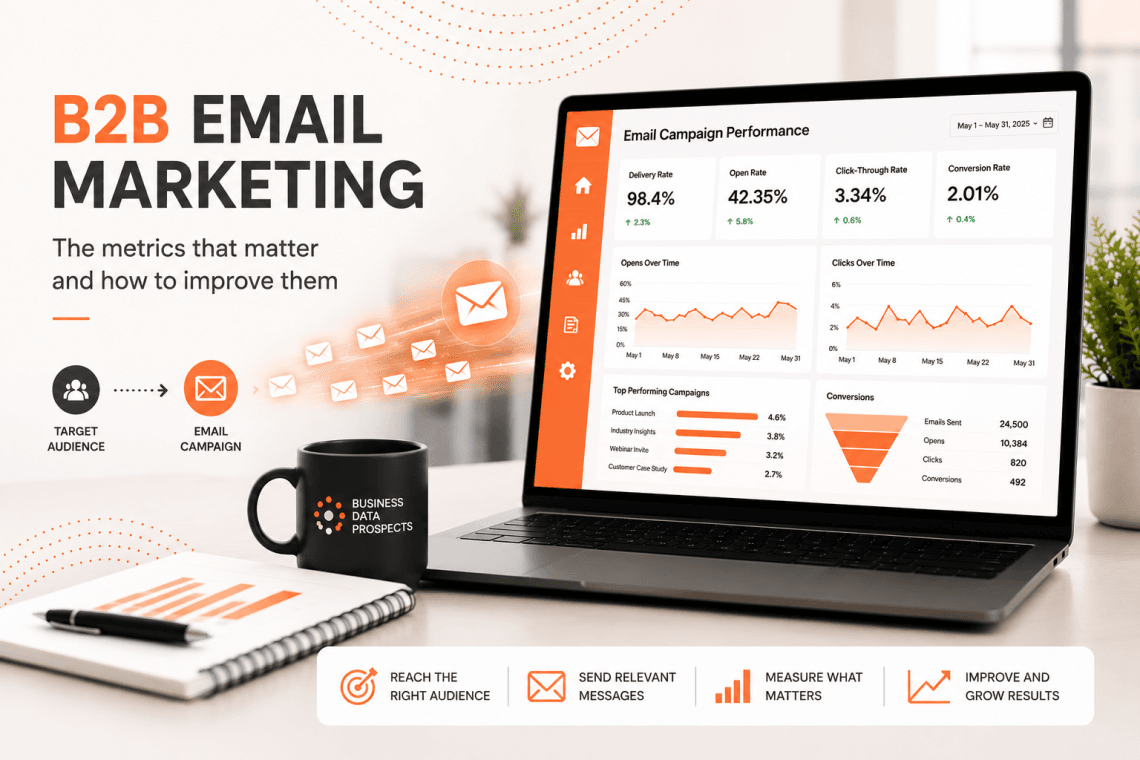
According to Brevo’s 2026 Email Marketing Benchmark Report, the average email open rate across industries is 42.35%, while the average click rate is 3.34%. Although these figures provide a useful benchmark, results vary considerably depending on your industry, audience, campaign objectives and whether you’re sending marketing emails or B2B prospecting campaigns.
From managed campaigns carried out by Business Data Prospects, we’ve found that the right audience has a greater influence on campaign performance. Once, the audience is correct, you can concentrate on refining your message so taht this is relevant. Businesses should use industry benchmarks as a guide, but compare performance against their own previous campaigns and continually refine their targeting over time.
To really understand your results, keep an eye on several key performance indicators, such as:
- campaign delivery rate
- click-through rate
- unsubscribe rate
- soft and hard bounces
- enquiries generated
- conversions
- return on investment
Reviewing these metrics after each campaign helps identify trends, improve targeting, and inform better marketing decisions.
Many underperforming campaigns share common issues that include:
- targeting an audience that’s too broad
- including multiple competing messages
- weak or unclear calls to action
- inconsistent campaign scheduling
- failing to review campaign performance
We’ve covered these in greater detail in our guide to common B2B email marketing mistakes.
Key B2B email marketing metrics
Reviewing several metrics together gives you a clearer picture of campaign performance than relying on open rates alone. Use the results to improve your audience targeting, message and future campaigns.
| KPI | How it is calculated | What it measures | What the result can indicate |
|---|---|---|---|
| Delivery rate | Delivered emails ÷ emails sent × 100 | Deliverability and list quality | A low rate may indicate deliverability issues. |
| Open rate | Opened emails ÷ delivered emails × 100 | Initial interest and subject-line performance | Shows whether recipients were encouraged to open the email. |
| Unique open rate | Unique recipients who opened ÷ delivered emails × 100 | Overall campaign reach | Prevents repeat opens by the same recipient from inflating the result. |
| Bounce rate | Bounced emails ÷ emails sent × 100 | Data accuracy and deliverability | A high rate may highlight outdated contacts or temporary delivery issues. |
| Click-through rate | Recipients who clicked ÷ delivered emails × 100 | Message and call-to-action engagement | Shows how effectively the email encouraged recipients to take the next step. |
| Unsubscribe rate | Unsubscribes ÷ delivered emails × 100 | Audience relevance and campaign frequency | An increase may suggest that the targeting, content or sending frequency needs reviewing. |
| Enquiry rate | Enquiries generated ÷ delivered emails × 100 | Lead generation effectiveness | Connects email engagement with genuine sales interest. |
| Conversion rate | Completed goals ÷ delivered emails × 100 | Campaign outcomes | Measures actions such as booked meetings, quote requests or purchases. |
| Return on investment | (Campaign revenue − campaign cost) ÷ campaign cost × 100 | Commercial performance | Shows whether the campaign generated sufficient value relative to its cost. |
Industry averages are useful reference points, but campaign results should also be compared with your own previous sends, audience segments and objectives.
Understand the legal framework
Alongside planning and measuring your campaigns, it’s important to understand the legal framework that applies to B2B email marketing in the UK. The Privacy and Electronic Communications Regulations (PECR) and the UK GDPR set out how organisations can use personal data for marketing and the responsibilities that come with it.
Rather than covering the legal detail here, we’ve explained it in our guide to Is It Legal to Buy Email Lists? including the legal basis for contacting business decision-makers and the practical considerations before launching a campaign.
Develop your email marketing further
Once you’re achieving consistent results, look for opportunities to improve future campaigns rather than making large-scale changes.
One of the simplest ways to do this is through A/B testing. Testing different subject lines, calls to action, or send times can help identify which approach generates the most engagement. Change one element at a time so you can clearly measure the impact of each adjustment.
As your campaigns develop, you may also want to explore:
- drip email marketing
- whitelist email marketing
- improving email deliverability
Each plays a different role depending on your objectives, audience and the type of campaign you’re running. If you don’t have the time or in-house resources to plan, send and optimise campaigns yourself, our managed email marketing service can manage the entire process on your behalf, from audience selection and campaign planning through to reporting and ongoing optimisation.
Continue improving your B2B email marketing
Successful B2B email marketing starts with reaching the right businesses. Even the strongest email will struggle to generate enquiries if it’s sent to the wrong audience.
Before launching your next campaign:
- Define a clear objective, whether that’s generating enquiries, booking meetings or promoting a new product or service.
- Build a targeted audience using high-quality B2B email data that matches your ideal customer profile.
- Segment your contacts by factors such as industry, job role, company size or location to improve relevance.
- Test different subject lines, calls to action and send times, measuring the results after each campaign.
- Use what you’ve learned to refine your targeting and improve future campaigns.
Small improvements across your audience, messaging and campaign timing can lead to significantly better long-term results.
If you already have the resources to send campaigns in-house, our B2B email data can help you reach relevant business decision-makers with confidence. If you’d rather leave the planning, sending and optimisation to specialists, our managed email campaigns service can manage the entire process on your behalf. Not sure who to target? Call our sales team and we’ll help define your ideal audience, recommend the right B2B email data and get your campaign off to the best possible start.
B2B email marketing FAQ
How long should a B2B marketing email be?
Most successful B2B marketing emails are concise and focus on a single objective. Rather than trying to explain every feature or benefit, introduce the key message, explain why it’s relevant and include a clear call to action. If recipients want more information, your website or landing page can provide the additional detail.
Why do B2B email campaigns fail?
Poor campaign performance is often caused by targeting the wrong audience rather than writing the wrong email. Other common reasons include unclear calls to action, inconsistent campaign scheduling, poor-quality data and failing to review previous campaign performance. Regular testing and audience refinement usually have a greater impact than continually rewriting email copy.
Can I send B2B marketing emails to cold prospects?
This is a very common search and lets you introduce the legal topic without repeating your legal section.
In many cases, yes, provided your campaign complies with UK legislation, including PECR and the UK GDPR. Before contacting business decision-makers, make sure you understand your legal responsibilities and use compliant B2B contact data. Read our guide to Is It Legal to Buy Email Lists? for a detailed explanation.
What makes a successful B2B email campaign?
Successful campaigns combine four key elements: a clearly defined objective, a well-targeted audience, relevant messaging and ongoing measurement. In our experience, businesses achieve the best long-term results by continually refining their audience and campaign performance rather than making large changes after every send.