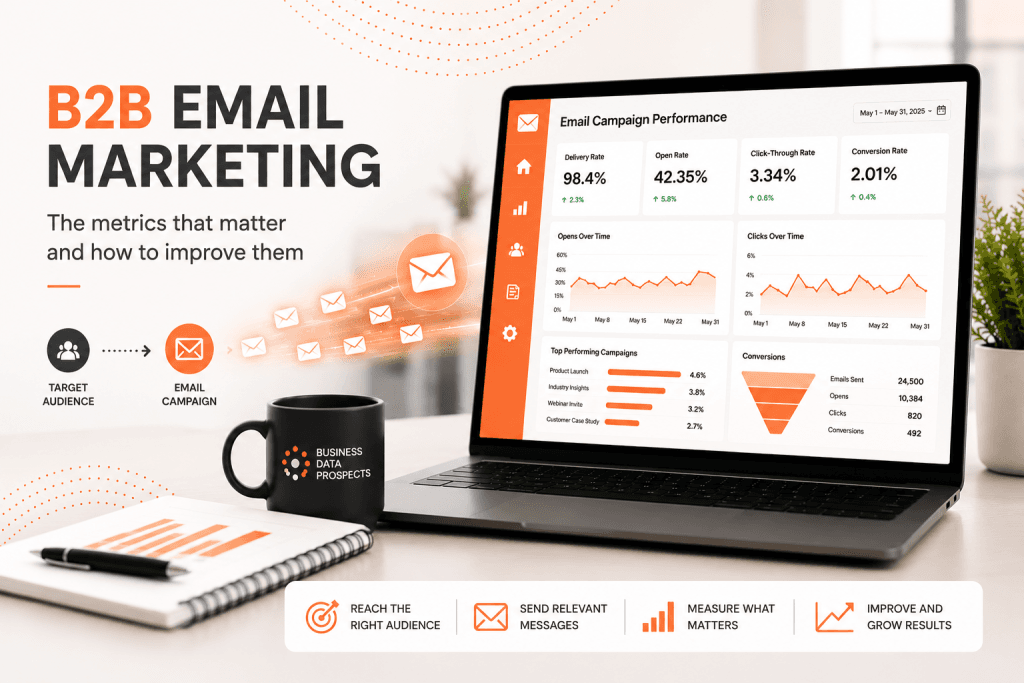
B2B email marketing is a great way to keep in touch with customers in the UK, and using the right approach, it can be an effective revenue stream. Here, we will cover how to stay compliant when emailing businesses in the UK and what the different consents are that cover both GDPR and PECR.
What is Email Compliance?
Email compliance refers to meeting the legal and regulatory requirements governing the sending, management, and control of marketing emails. Rather than focusing solely on the content of an individual message, compliance looks at the full lifecycle of email marketing activity, including how contact data is collected, the lawful basis for processing it, how recipients are identified and informed, and how opt-out or objection requests are handled.
In the UK and Europe, email compliance is covered by data protection and electronic communications regulations, both of which are governed by the Information Commissioner’s Office in the United Kingdom, and require transparency about the sender’s identity, clarity about why a recipient is being contacted, and effective safeguards to protect personal data.
Organisations must be able to demonstrate that their email practices are lawful, proportionate, and respectful of recipient rights, with appropriate controls in place across data storage, usage, and suppression.
How GDPR Applies to B2B Email Marketing
GDPR email marketing is often misunderstood in UK B2B contexts, leading many organisations to assume consent is always required or to avoid email marketing unnecessarily. This often leads businesses either to seek unnecessary consent or to avoid email marketing altogether.
The overall message is to ensure that you have a lawful basis to send emails. In B2B email marketing, this is typically established through legitimate interest, rather than explicit opt-in, provided the email is relevant to the recipient’s professional role and the use of their data is proportionate and expected.
Organisations may also email contacts who have subscribed to receive communications or who have an existing business relationship. In every email, recipients must be given a clear opportunity to opt out, and email activity must comply with GDPR and PECR requirements. This is one of the reasons that we always recommend an Email Service Platform rather than using Outlook or a free email system.
Even where lawful processing is in place, inbox placement is not guaranteed. Corporate email systems assess sender reputation, infrastructure, and trust signals when determining whether messages reach the inbox, which is why practices such as whitelist email marketing are important for ensuring compliant B2B emails are delivered.
GDPR vs PECR
This is a common source of confusion. Understanding the difference between these regulations is important because both must be adhered to for successful compliance in email marketing. GDPR governs the lawful processing of personal data and PECR governs electronic marketing communications, including email.
In B2B email marketing:
- GDPR determines whether you can process the data.
- PECR determines how you send the email.
Both must be met.
In the UK, the Information Commissioner’s Office provides specific guidance on how GDPR and PECR apply to business-to-business marketing.
Finally, you must always identify the sender, avoid misleading content, and include opt-outs under PECR. Compliance is required in both cases.
Lawful Bases (Legitimate Interest vs Consent)
When weighing your options, start here: GDPR provides several lawful bases for processing data. For UK B2B email marketing, the two most relevant are legitimate interest and consent.
For most B2B email marketing activity, legitimate interest, rather than consent, is the appropriate lawful basis where communications are relevant to the recipient’s professional role, expected, and proportionate.
This requires that:
- The processing serves a legitimate business purpose.
- The recipient’s rights and freedoms are not overridden.
- A clear and simple opt-out is provided in every email.
GDPR regulates the lawful use of personal data; it does not prohibit B2B email marketing where an appropriate lawful basis is in place, and PECR requirements are met. In short, UK businesses can send B2B marketing emails under GDPR when legitimate interest is applied correctly and supported by transparent email practices.
Legitimate Interest (most common)
Legitimate interest is typically appropriate where:
- The email relates directly to the recipient’s business role.
- The product or service is relevant to that role.
- The impact on the individual is minimal.
- Safeguards such as opt-outs are in place.
UK GDPR Recital 47 recognises that direct marketing may constitute a legitimate interest where the balancing test is satisfied.
Consent (less common in B2B)
Consent may be required where:
- The marketing activity is high-risk or unexpected.
- The recipient has no reasonable expectation of contact.
- PECR rules specifically require consent.
In most B2B scenarios, re-consenting an entire database is unnecessary and often results in avoidable data loss without improving compliance.
Approaches to Compliant Email Marketing
Compliant email marketing is built around transparency, lawful processing, and respect for recipient rights. Under UK GDPR and PECR, organisations must clearly identify themselves as the sender, explain why the recipient is being contacted, and provide a simple, immediate way for the recipient to opt out of future emails. The specific compliance approach depends on the lawful basis being relied upon and how contact data has been obtained and managed.
In practice, compliant email marketing typically involves a combination of the following:
- Consent-based emailing, where individuals have actively opted in by clicking on an email regarding marketing communications. Any consent relied upon must be recorded with no pre-ticked boxes or implied permission.
- Existing customer or relationship-based emailing, follow-up marketing may be permitted, provided recipients were informed at the point of data collection and can easily opt out of future communications.
- Legitimate interest-based emailing is commonly used in B2B marketing where communications are relevant to the recipient’s professional role and do not override their rights or expectations.
- Operational compliance controls, including accurate sender identification, non-misleading subject lines, clear unsubscribe mechanisms, and prompt handling of objections and suppression requests.
- Data governance measures, such as maintaining accurate, up-to-date records, securing contact data on trusted platforms, and documenting the lawful basis for each campaign.
For most UK B2B email marketing activity, legitimate interest is the most appropriate and proportionate lawful basis, provided it is assessed correctly and supported by transparency, relevance, and, of course, an easy opt-out process.
Legitimate Interest in B2B Email Marketing (Explained)
Relying on legitimate interest requires applying a three-part test:
- Define the purpose – Identify and clearly state the legitimate business purpose.
- Assess necessity: determine whether email marketing is necessary to achieve this purpose.
- Weigh the balance – Evaluate whether the individual’s rights override your interests.
In practice, this means:
- Emails must be relevant and targeted.
- You must be transparent about your identity.
- Objections must be honoured immediately.
- Suppression lists must be maintained.
At Business Data Prospects, legitimate interest is evaluated during both data collection and data licensing to ensure marketing activity remains aligned with ICO expectations.
To support this process, maintaining clear documentation is best practice. A simple legitimate interest assessment may include:
A. Purpose of Processing
State the legitimate business purpose.
Example: “To communicate with potential clients in related industries about relevant services.”
B. Necessity Assessment
Explain why email marketing is required to achieve this purpose.
Example: “Email marketing provides a direct and proportionate method of reaching the intended audience.”
C. Balancing Test
Describe how the rights and freedoms of recipients are protected.
Example: “Communications are role-relevant, include a clear opt-out, and are limited to business-related content.”
D. Conclusion and Record Keeping
Summarise the assessment and retain supporting documentation to evidence compliance with GDPR and PECR.
This approach provides a practical, auditable framework for applying legitimate interest in B2B email marketing.
Buying and Using B2B Email Data
Using third-party B2B data is lawful under GDPR when:
• The data has been collected under a valid, lawful basis.
• Transparency obligations have been met.
• The intended use is compatible with the original intended purpose.
• Objection and suppression processes are in place.
Corporations must ensure that any B2B data they use:
• Is accurate and up to date.
• Has been obtained fairly.
• Includes role-based relevance.
• Is supported by clear documentation.
Clarifying what constitutes compliant data sourcing is essential, especially as disclosure and messaging requirements impact lawful email marketing.
At Business Data Prospects, we distinguish between licensing compliant B2B data and “buying bulk email lists,” the latter being a term commonly associated with non-compliant consumer practices. Businesses often ask whether purchasing email data itself is permitted under UK law. Read our guide on is it legal to buy email lists in the UK for a detailed explanation of GDPR, PECR and legitimate interest requirements.
To make informed, compliant choices, consider:
How do you ensure the data you provide has been collected lawfully?
Can you provide documentation of consent or legitimate interest assessments?
What processes do you have in place to maintain data accuracy and recency?
Additionally, be vigilant for warning signs in suppliers. Red flags include suppliers who cannot explain their data sources, those who refuse to provide documentation, and those who offer suspiciously inexpensive lists without credible sourcing information.
Transparency & Opt Outs
Both GDPR and PECR require transparency in email marketing, which should not be seen solely as a compliance obligation, but as an opportunity to build trust with your audience.
This includes:
• Accurate “From,” “To,” and “Reply-To” information is essential for ensuring the recipient knows exactly who is contacting them.
• A clearly identifiable sender reassures recipients that they are engaging with a legitimate and responsible business.
• Subject lines that precisely reflect the content offer recipients a clear sense of what they can expect.
• No misleading or deceptive messaging helps preserve integrity with prospects and clients.
Recipients must be able to immediately understand:
- Who is contacting them? Transparency here helps build a recognisable brand identity.
- Why are they being contacted? Clear reasons for communication affirm the relevance and legitimacy of the email.
- How to opt out. An easy opt-out process is actually great for brand recognition, as it gives recipients control over their inbox.
By carrying out these actions, businesses can build a trusted relationship with prospects and leverage compliance requirements as a foundation for stronger marketing connections. Next, we address how to properly manage opt-outs and objections, as failure in this area may also affect compliance and deliverability.
Opt-Outs, Objections and Suppression
Every B2B marketing email must include:
• A clear and simple opt-out mechanism.
• Prompt honouring of objections.
• Ongoing prevention of re-contact.
Under GDPR, individuals hold the right to object to direct marketing at any time. Once an objection is received:
• The data must no longer be used for marketing.
• Suppression must be permanent.
Data Validity, Recency and Continuous Compliance
GDPR requires that personal data must be:
• Accurate
• Kept up to date
• Not retained longer than necessary.
For B2B email marketing, this means:
• Regular data cleansing
• Bounce and suppression management
• Periodic review of relevance
• Documented compliance processes
Keeping data accuracy and adherence is not simply a one-time task, but an ongoing commitment.
Have you established a regular schedule to review and update your data to ensure compliance?
Setting up a routine on a quarterly basis can greatly improve the effectiveness and compliance of your data. For instance, consider adopting a quarterly data-cleansing process that includes verifying contact details and removing outdated information.
Using outdated or poorly maintained data increases both legal risk and the likelihood of inbox filtering.
Most email service providers produce a report for every email campaign, listing which emails were not delivered. We recommend you download this monthly and update the suppression lists and your CRM, if they are not already connected. This can also help reduce unnecessary risks and maintain compliance at both local and company-wide levels.
Common Myths About GDPR and B2B Email Marketing
Myth: GDPR bans unsolicited B2B emails
GDPR does not prohibit B2B email marketing. Lawful B2B outreach remains permitted where there is a valid lawful basis, most commonly legitimate interest, and where PECR requirements such as transparency and opt-outs are met.
Myth: Consent is always required
In most UK B2B email marketing scenarios, consent is not required. Legitimate interest is often the more appropriate lawful basis when communications are relevant and proportionate, and include a clear opt-out.
Myth: GDPR only applies to consumer data
GDPR applies to personal data, including identifiable business contacts such as named email addresses linked to individuals within organisations. B2B marketing activities must therefore comply with the GDPR when personal data is involved.
Myth: Re-consenting fixes compliance
Re-consenting an entire B2B database is rarely necessary and often leads to unnecessary data loss. Compliance is achieved through selecting the correct lawful basis, maintaining accurate records, and applying proper data governance, not through blanket consent exercises.
GDPR Email Marketing FAQs (UK B2B)
Yes. UK GDPR allows B2B marketing emails where there is a lawful basis for processing, most commonly legitimate interest, and where PECR requirements such as disclosure and opt-outs are met.
In most B2B scenarios, consent is not required. Legitimate interest is usually more appropriate where emails are pertinent to the recipient’s professional role and include a clear opt-out.
Legitimate interest is a lawful basis under the GDPR that permits businesses to process personal data for marketing purposes when the activity is necessary and proportionate and does not override the individual’s rights.
Yes. GDPR applies to personal data, including identifiable business contacts such as named email addresses linked to individuals within companies.
GDPR governs how personal data is processed. PECR governs how electronic marketing messages are sent. Both must be complied with when running B2B email campaigns.
Businesses may license compliant B2B data that has been collected lawfully, is relevant, transparent, and supported by suppression and objection-handling processes. This is different from non-compliant “email lists”.
Yes. PECR requires that recipients be given a simple and effective way to opt out of future marketing emails at all times.
Once an objection is received, the individual’s data must no longer be used for marketing and should be added to a permanent suppression list.
Conclusion
UK GDPR email marketing is about following best practices, not avoiding email altogether.
Businesses that understand legitimate interest, respect PECR rules, and use compliant B2B data can continue to run effective email campaigns without unwarranted risk.
GDPR email marketing is not about stopping B2B email campaigns. It means ensuring marketing activity is lawful, transparent, and proportionate. Review your current processes and update your approach to maintain continuous compliance and effectiveness.
The following steps we recommend you do today include:
- Always mark the source of your data so you can later identify how you collected the contact details.
- document the lawful basis for processing data in your company, and
- Update your opt-out processes to conform to best practices.
By carrying out these actions, you can move forward confidently, knowing your email campaigns are on the right track.
Compliance is not achieved through blanket consent requests or avoidance, but through clear lawful bases, proper safeguards, and accountable data practices aligned with regulatory expectations. Take steps now to review, refine, and document your email marketing processes for ongoing success.
By following these tips, you can ensure your B2B email data lists in the UK support compliant, effective, and successful GDPR email marketing campaigns.